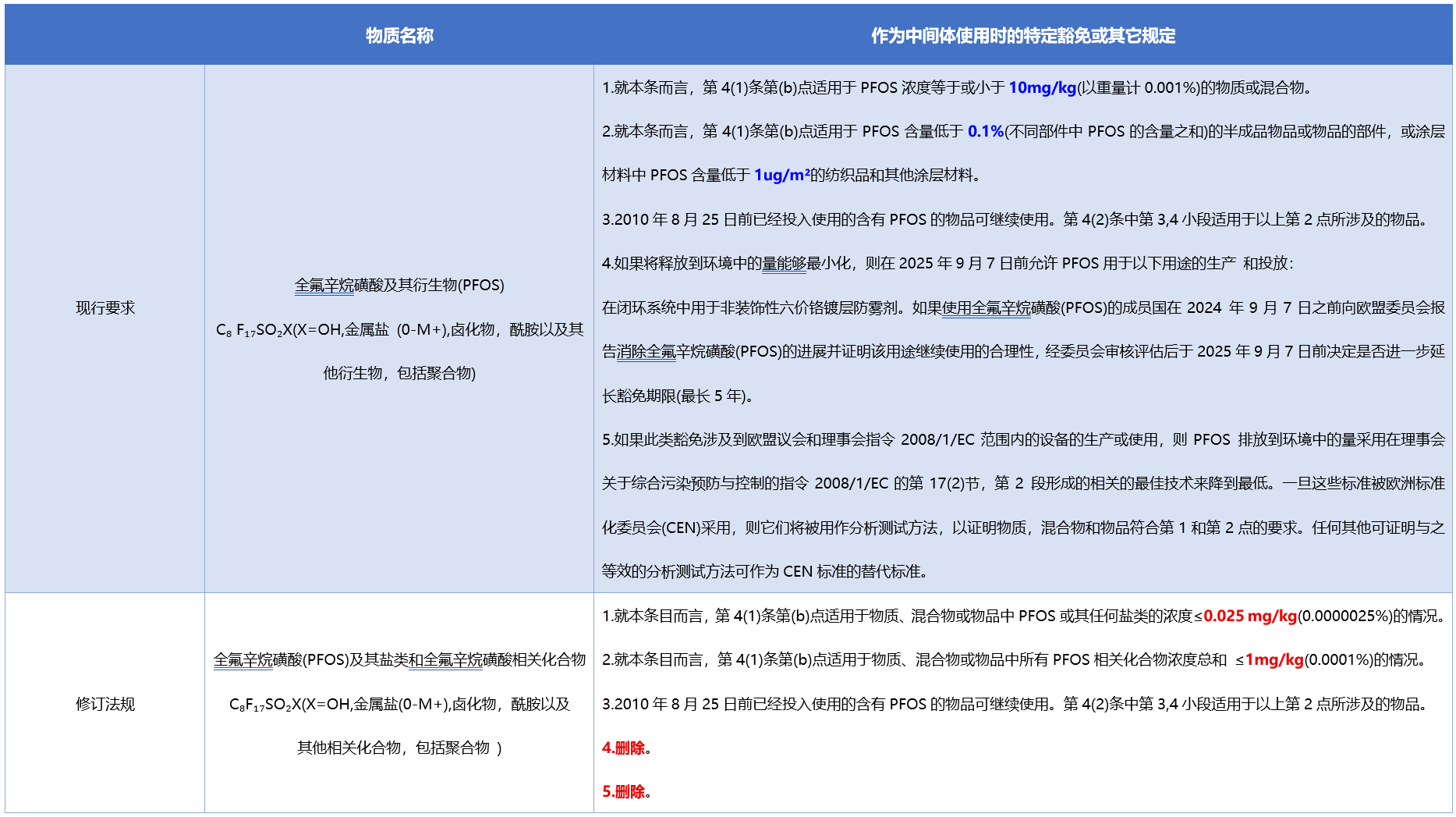
On June 27, 2025, the European Commission published Regulation (EU) 2025/718 in its Official Gazette (OJEU), formally revising the limits for perfluorooctane sulfonic acid (PFOS), its salts and related compounds in Annex I of the EU Persistent Organic Pollutants (POPs) Regulation (EU) 2019/1021. The revised regulations will take effect on July 17, 2025 and will be implemented from December 3, 2025.
The revised regulations are compared as follows:
About PFOS
Perfluorooctane sulfonic acid, abbreviated as PFOS, is a general term for perfluorooctane sulfonic acid-based compounds. It has the characteristics of oleophobicity, hydrophobicity, and antifouling. It is widely used in various fields such as paper, coatings, textiles, carpets, firefighting foams, imaging materials, and aviation hydraulic oils. PFOS has very stable chemical properties and is often used as an intermediate in the production of coatings, fire extinguishing foams, floor treatment agents, food contact materials, especially fiber paper materials and non-stick pan coatings.
About POPs Regulations
Persistent organic pollutants (POPs) refer to organic chemicals synthesized by humans that can persist in the environment, have a long half-life, can accumulate through the food web, and have adverse effects on human health and the environment. They can cross international borders through the atmosphere, water or migratory species to reach areas where they have never been produced or used (such as migrating from Asia to Antarctica). Therefore, global risk management is necessary because no region can manage the risks posed by these substances alone.
The EU POPs Regulation is the EU Regulation on Persistent Organic Pollutants, with the regulation number (EU) 2019/1021, and the controlled substances are persistent organic pollutants. The purpose of this regulation is to eliminate or ban the production, sale and use of persistent organic pollutants (POPs) involved in the Stockholm Convention on Persistent Organic Pollutants in the EU as soon as possible, so as to protect humans and the environment from the hazards of persistent organic pollutants and reduce the emission of such substances in the environment as much as possible.
Warm Tips
The EU POPs regulations are frequently updated and the enforcement is constantly strengthened. There are many cases where related products have been reported for violations of POPs regulations. ZRLK recommends that relevant companies always pay attention to the dynamics of regulations, formulate corporate control measures, and reduce the economic losses caused by product violations of POPs regulations. Our company has a wide range of testing fields and a professional and efficient service team, which can help companies evaluate the special chemical substances regulated in products so that your products meet the standards of corresponding national and international organizations. If you need it, please feel free to contact us, our engineers will serve you as soon as possible!